


The Thought Spirals We Do Not Even Notice

We all have moments when one small thought grows a little bigger and suddenly the mind is running ahead on its own. Most spirals are tiny. They quietly shape our mood without us realising.
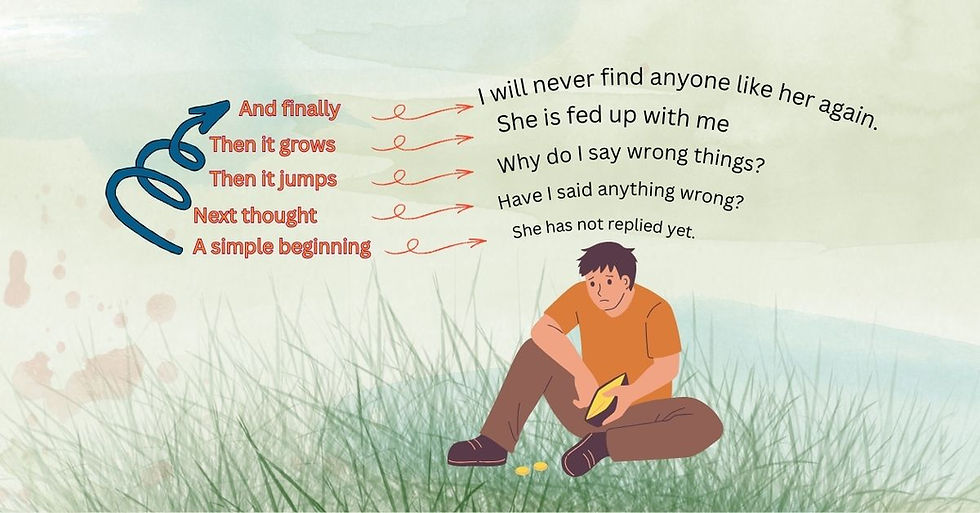
What a thought spiral looks like
All this happens in seconds. One small thought becomes a full story and the emotion arrives fast. Sometimes it is heaviness, shame or inward anger. Sometimes it is panic and fear.
How people react
People may react to thought spirals in different ways.
Some people blame themselves and slip into self criticism. As a result, they feel low and withdraw from activities they normally enjoy. They may skip food, become quiet, and cut off from social engagement. The emotion turns inward and the body feels dull and tired.
Others move into a panic mode. Their heart races, breathing becomes quick, and they feel a strong need to fix things instantly. They may apologise repeatedly, send multiple messages, or call again and again. They try to calm their fear by seeking reassurance.
Both reactions come from the same place, a spiral that felt real.
Some examples of everyday spirals
Workplace spiral
⬇️
Trigger
Manager looks serious today.
⬇️
Automatic Thought
Maybe my last email was
not good enough
⬇️
Next Thought
They are disappointed with me.
⬇️
Emotion
Worry/anxiety/panic
⬇️
Physiological Reaction
Tightness in the chest
⬇️
Behaviour Reaction
Overchecking work, rewriting emails, avoiding asking questions.
Friends spiral
⬇️
Trigger
Some friends are meeting.
⬇️
Automatic Thought
They all planned a meet
up without me.
⬇️
Next Thought
Maybe I am not
fun to be around.
⬇️
Next Thought
I think the group does
not value me anymore.
⬇️
Emotion
Loneliness
⬇️
Physiological Reaction
Heavy feeling in the body
⬇️
Behaviour Reaction
Pulling back, replying late, pretending it does not matter.
Social media spiral (FOMO)
⬇️
Trigger
Watched reels about people
having a cool life
⬇️
Automatic Thought
Everyone is out having fun tonight.
⬇️
Next Thought
My life is so dull compared to them.
⬇️
Next Thought
I am missing out on everything.
⬇️
Emotion
Envy, jealousy, FOMO
⬇️
Physiological Reaction
Headache, body ache
⬇️
FOMO Behaviour Reaction
Scrolling without stopping, comparing life choices,
feeling drained.
Why spirals feel real
Spirals feel real because the brain fills gaps with guesswork. When it does not have full information, it creates a story that feels safer than silence. The mind likes certainty, even if the certainty is negative.
Once the first few thoughts appear, the body joins in. A faster heartbeat, a tight jaw, a warm face or a heavy chest. The body reacts to the thought as if the event is actually happening. This physical response makes the thought feel like a fact.
When thoughts and body sensations mix, the spiral feels true. It becomes a loop. Something small becomes something serious in minutes. This is human. Not a flaw.
How to break the spiral loop
Here are some techniques that can bring you back to the present, slow the chain and help the brain reset.
1. Grounding technique: Notice five things around you that you can see. Touch something cool or textured. Take a slow breath. This brings the body back to the present moment so the spiral loses power.
2. Name the first thought: Say in your mind, This is the first thought that started the spiral. Naming it separates you from it. The story stops growing.
3. Fact check: Ask one simple question: What proof do I have right now? Most spirals collapse here because they are based on assumptions, not facts.
4. Shrink the story: Come back to the smallest next step. Let me finish one task. Let me wait till I hear from them. A small step breaks a big loop.
5. Body reset: Relax the shoulders. Unclench the jaw. Take a slow exhale. When the body calms, the mind follows.
A quiet reminder
Spirals are normal. They happen to everyone. What matters is noticing the first link before the whole story takes over. Even one small pause can change the direction of your day.
Try catching one spiral this week. Not all of them. Just one. Notice how your mind moves and how your body responds. You may be surprised by how quickly a small pause brings clarity.
If you find yourself spiralling often or feeling stuck in these loops, CBT can help you understand the pattern, slow it down and build calmer responses. Therapy is not only for big crises. It also supports the everyday mind.
If you are a parent, this is the best time to introduce your child to the basics of CBT. Early awareness builds emotional strength that lasts for life. Check out our resource library and help children help themselves


Comments